
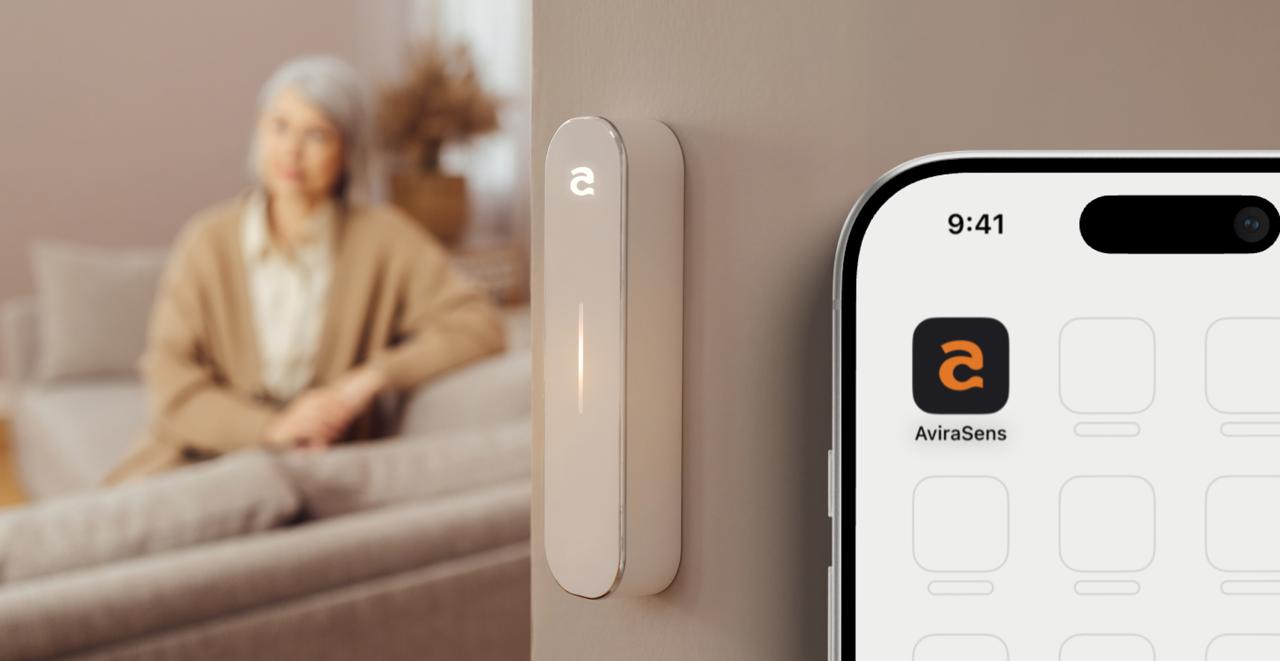
From a sensor in the room to a calm notification for the family
The system watches how the home is used, learns the daily rhythm and speaks only when something really differs from the norm. No cameras and no wearables.
All behaviour analysis happens at home, on the local hubFour steps: from the sensor to the application
Sensitive data does not leave the home. Only the result of the analysis goes outside — information about an event, not a record of daily life.
Sensors in the home
Discreet sensors register movement, door openings and presence in rooms. No cameras, no microphones, no wristbands.
Local hub (Raspberry Pi)
All signals go to a small computer inside the home. It collects the data and runs the whole system.
Analysis at home
The hub learns the daily rhythm and analyses behaviour locally. Raw sensor data stays inside the home.
Notification in the app
The hub sends only the result of the analysis to our backend. The backend prepares a clear notification for children and relatives in the app.
Only information about a meaningful event leaves the home — no recordings, no video and no log of every movement.
14 days to learn the habits
Learning
For 7–14 days the system learns the daily plan: sleep, getting up, the bathroom, meals and going out.
Personal norm
A typical picture is built: the time, the length and how often each activity happens.
Looking for deviations
A long time in the bathroom, no getting up in the morning, no activity, an exit at night.
Confirmation
Data from several sensors is compared — this gives fewer false alarms.
Adaptation
The model updates itself and adapts to changes in the habits.
The family does not get a notification about every sensor signal, only about a meaningful deviation from the usual behaviour.
Sensitive data stays at home
Privacy is built into the system design, not added at the end.
Join the AviraSens pilot
We invite families and care facilities to join our research. Leave your contact or fill in a short anonymous survey.